
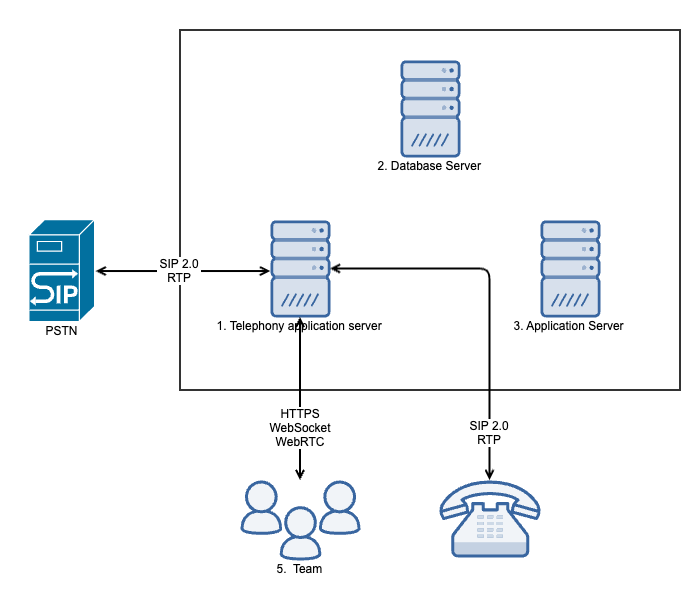
This section describes the basic architecture of the Webitel production environment designed for approximately ~400,000 calls and ~100,000 chats per day.
1. General Architecture Diagram
2. Deployment Environment Requirements
The Webitel architecture is designed to operate in environments with isolated and guaranteed resources. Using budget VPS/VDS (Virtual Private/Dedicated Server) instances with shared CPU time is not recommended due to the risks of “noisy neighbors” and high network latency, which is critical for the quality of VoIP components (FreeSWITCH, RTP, OpenSIPS).
Supported platforms include:
-
On-Premise (Local servers):
-
Physical servers (Bare Metal);
-
Enterprise hypervisors (VMware, KVM, Xen, Proxmox VE).
-
-
Cloud Providers:
-
AWS (Amazon EC2);
-
Google Cloud (Compute Engine);
-
Microsoft Azure (Virtual Machines);
-
DigitalOcean (Droplets);
-
Hetzner (Cloud / Dedicated).
-
IMPORTANT! When choosing cloud provider plans (especially DigitalOcean and Hetzner), it is strongly recommended to select virtual machines in the following categories:
-
Dedicated vCPU, or
-
Compute-Optimized,
for components responsible for media and voice processing.
3. Description of the General Infrastructure
For an industrial environment with an average load of up to 400,000 calls per day (250–350 simultaneous with call recording) and about 100,000 chats per day, it is necessary to prepare 3 virtual machines (items 1–3 in the table below).
Deployment requirements:
-
Install only the operating system, and keep Internet access enabled to download and install all additional software.
-
After the installation is complete, Internet access on the virtual machines may be disabled.
-
Developers must be provided with SSH access using root privileges for the duration of installation and testing.
-
Virtual machines 1–3 must operate within the same VLAN, with no traffic filtering (allow all ports).
-
The reservation should be provided by the capacity of virtual machines.
4. Server Specification
|
Object |
Software |
Resources (min) |
Connectivity |
Description |
|---|---|---|---|---|
|
Debian 13 Linux 64bit — basic server installation with SSH connection; Additionally, we will install: OpenSIPS 3.4; rtpengine; nginx; SSL; |
|
in-out: 80/tcp, 443/tcp, 5060/tcp, 5060/udp in-out: 10000-50000/udp |
Telephony server. SSL certificates with a trusted CA are required to provide a secure connection via HTTPS protocol and telephony in a browser.
|
|
Debian 13 Linux 64bit — basic server installation with SSH connection; Additionally, we will install: Linux; PostgreSQL 15; Grafana; Consul; RabbitMQ; |
|
|
We recommend duplicating the server to configure Streaming Replica. |
|
Debian 13 Linux 64bit — basic server installation with SSH connection; Additionally, we will install: FreeSWITCH 10; Webitel FlowManager; Webitel App; Webitel API GW; Storage; CallCenter; Engine; Messages |
|
|
|
|
|
|
|
Interaction with external systems runs via HTTP REST. |
|
Microsoft Windows 11 / Linux 64bit Google Chrome / Microsoft Edge (the latest or previous version) |
|
Connection to the IS not less than 2 Mb/s per user, with delays of no more than 15-20 ms. |
Employees’ workplace |
|
|
|
Connection to the IS not less than 5 Mb/s per device, with delays of no more than 15-20 ms. in-out: 5060/udp, 10000-20000/udp |
Hardware phone with SIP 2.0 protocol support |
|
|
|
|
Public Switched Telephone Network is a general subscriber communication network, the access to which is provided by telephone sets, PBX, and data transmission equipment. |
5. Network Parameter Requirements
|
|
Connection speed |
Delay (Ping) |
Jitter |
Packet Loss |
|---|---|---|---|---|
|
WebRTC |
|
|
|
|