
1. Description
It is designed to set the calendar working time relative to the working week.
The table consists of entries for each day of the week.
Consists of columns:
-
Name;
-
Start;
-
End;
-
State;
-
Tools for action.
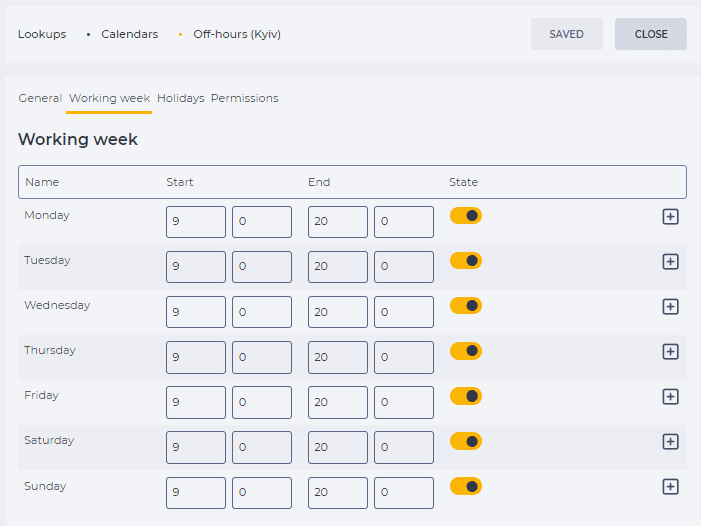
Fig. 1. Working week tab
1.1. Name
The name of the day of the week is displayed here. If the day is not shown, then the entry is relevant for the day indicated above (Fig.2).
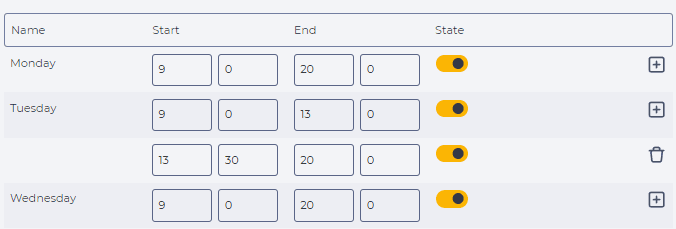
Fig. 2. Several periods for one day
1.2. Start
The Start column consists of two fields that indicate the interval's start time. In the first field, enter hours; in the second field, enter minutes.
1.3. End
The End column consists of two fields that indicate the interval's end time. In the first field, enter hours; in the second field, enter minutes.
1.4. State
The switch is responsible for enabling and disabling the calendar work in this time interval.


1.5. Tools for action
There are two tools:
-

-

1.5.1. Add tool
It appears for main records that have a day's name.
When you click on the add
Attention!
The added entry must have a time interval that does not include the time entered in the other entries for that day.
1.5.2. Removal tool
It is displayed for additional entries. The additional entries do not have a day's name (Fig. 2). Clicking the button deletes the entry.
2. Opportunities
2.1. Set calendar working hours by day
|
Goal |
Set the working time of the calendar by day: Mon-Fri from 10:00 to 21:00; Sat from 10:30 to 14:00; Sunday - day off |
|---|---|
|
Preconditions |
|
|
Steps
|
|
|
Result |
Data saved. |
2.2. Set several time intervals for one day of the week
|
Goal |
Set working hours for the day shift (from 8:00 to 19:45) and night shift (from 20:00 to 7:45) on Monday |
|---|---|
|
Preconditions |
|
|
Steps
|
|
|
Result |
Data saved. |

2.3. Remove an additional timeslot
|
Goal |
Remove an additional timeslot |
|---|---|
|
Preconditions |
|
|
Steps
|
|
|
Result |
Data saved. |
